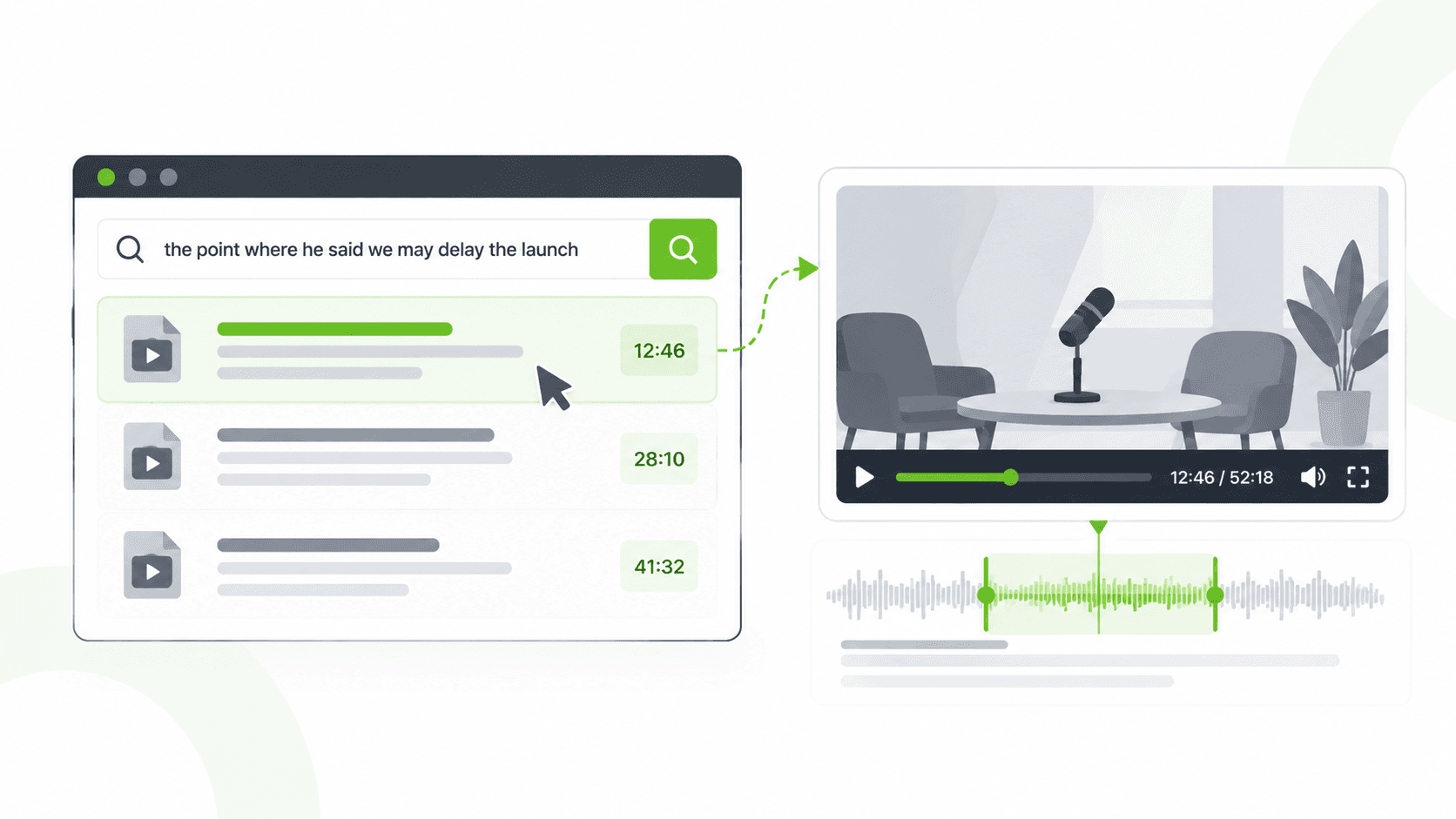
Finding a sentence in a transcript is not the end of a reporting workflow.
It is the start of verification.
Automatic transcription is useful because it makes spoken material searchable.
The original recording remains the source.
Speech recognition can mishear:
A transcript can look convincing while still containing an important error.
For direct quotation, that matters.
The safest retrieval workflow connects every search result back to its source.
Find the relevant passage.
Open the recording at the timestamp.
Listen to the sentence.
Then listen a little before and after it.
This lets you confirm both the wording and the context.
A technically accurate sentence can still be misleading if removed from its surrounding conversation.
Ask:
Search helps you reach the material.
Editorial judgment determines how it should be used.
This is one reason Ugle is designed around timestamped Moments and source playback rather than generated answers.
A result should be inspectable.
You should be able to ask, “Where did this come from?” and immediately return to the recording.
That matters for journalism.
It also matters for documentary work, research, podcast production and any workflow where the source itself matters.
Search is useful because it shortens the path back to the evidence.
Share this post