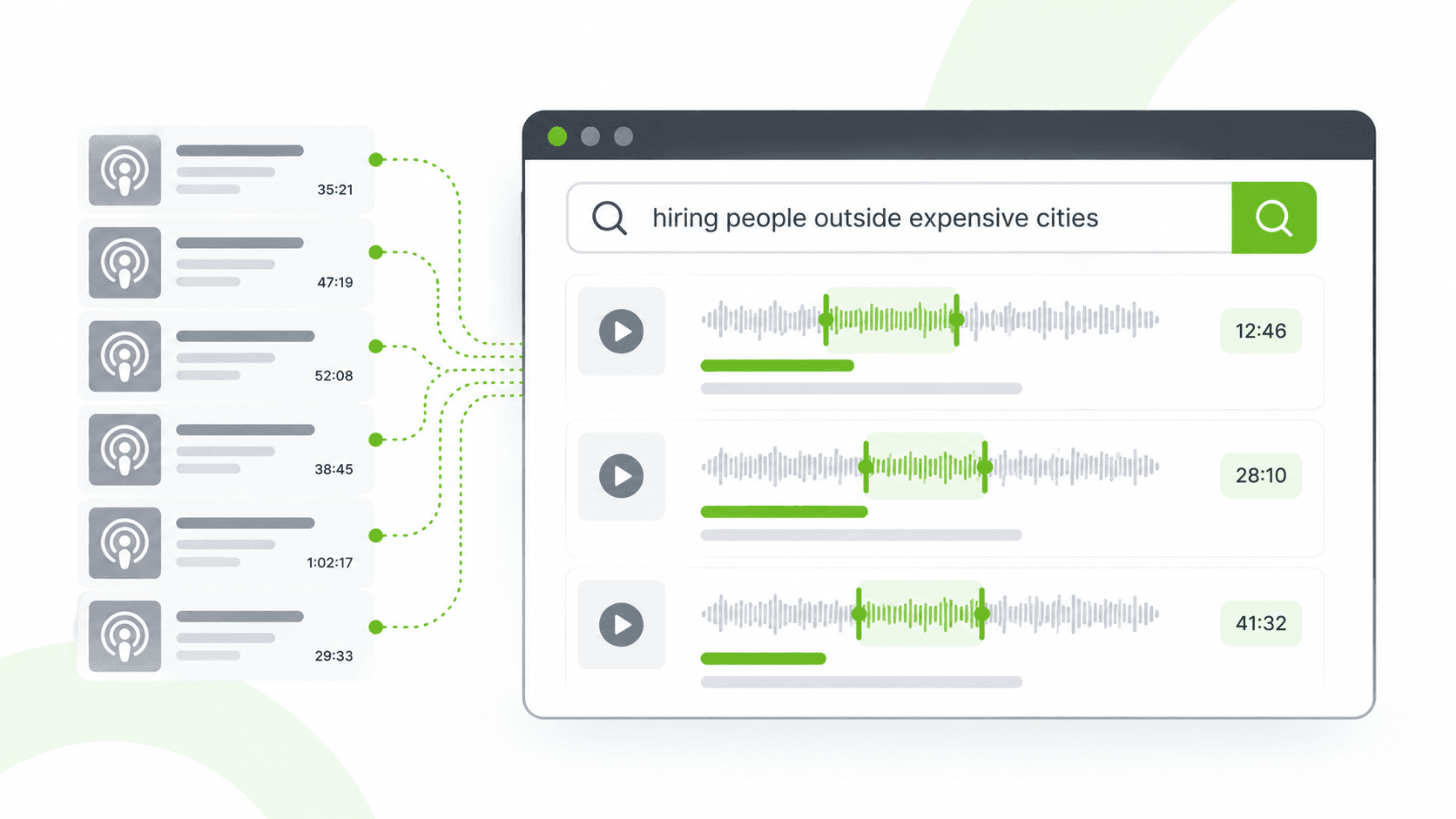
A podcast archive gets more valuable every time you publish.
It also gets harder to remember.
After a few years, you may have hundreds of hours of conversations containing opinions, predictions, stories and soundbites that could be useful again.
The problem is retrieval.
Episode titles and show notes describe what an episode was about.
They do not necessarily capture everything that was said.
A guest may spend two minutes discussing an idea that never appears in the episode description.
Six months later, that may be exactly the passage you need.
Searching the spoken content gives you another way into the catalogue.
Suppose you are producing an episode about remote work.
You remember several previous guests discussing hiring people outside major cities, but you cannot remember which episodes.
You could search the archive for:
“hiring people outside expensive cities”
Relevant passages can surface even when every guest used different wording.
From there, review the timestamped Moments and play the original audio.
Archive search is not only useful for repurposing.
A returning guest may have appeared eighteen months earlier.
Before the new recording, search their previous conversation for topics such as:
“what she predicted about interest rates”
“the part where he discussed expanding internationally”
That gives the producer specific threads to revisit.
The archive becomes research material rather than a folder of finished episodes.
Finding an old passage is only the first step.
Listen to the original context.
Check whether the statement still makes sense today.
Confirm that the excerpt represents what the guest actually intended.
Then decide whether it belongs in the new piece.
Search accelerates retrieval.
It should not remove editorial judgment.
Make the spoken content searchable.
Share this post