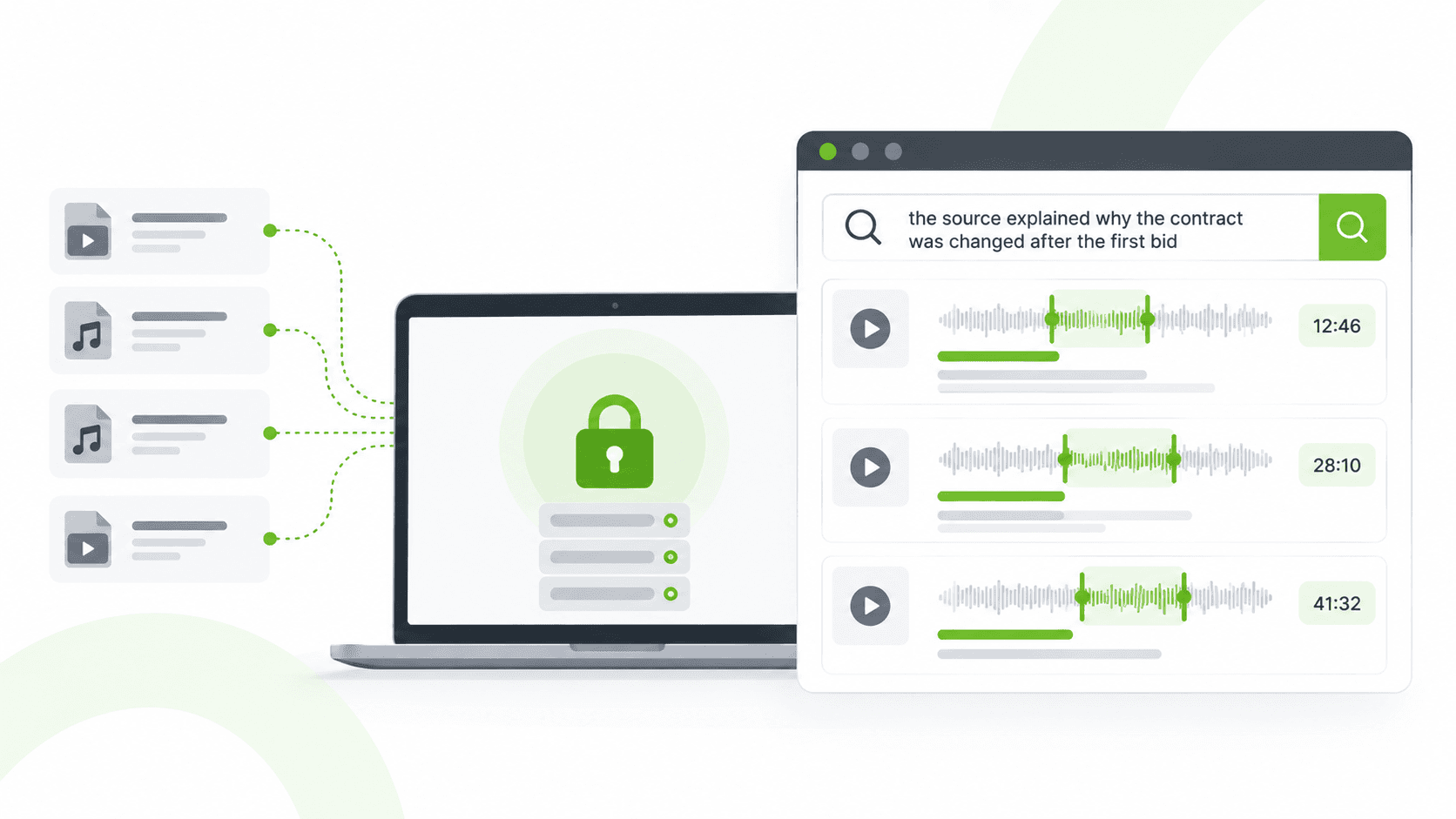
Interview recordings accumulate quickly.
The reporting question six months later is often simple:
“Where did that source say that?”
The answer may be somewhere across dozens of recordings.
Finding it manually means reconstructing the interview from filenames, dates, notes and memory.
There is another approach: make the recordings searchable on the machine where you keep them.
In a local-first workflow, the core processing happens on your device.
For Ugle, the media is transcribed and indexed locally. Search queries run against that local index.
That means the reporting workflow does not require uploading source recordings and transcripts to a remote processing service during normal operation.
Operational functions such as software licensing and updates are separate from the media-search workflow. Current details should always be checked on Ugle's Security and licence pages.
Journalists often remember meaning better than filenames.
You may remember:
“the source explained why the contract was changed after the first bid”
but not which interview contained it.
Semantic retrieval lets you search for the remembered idea rather than depend entirely on exact words.
Matching Moments can then lead back to their original recordings and timestamps.
Local processing reduces one type of exposure.
It does not automatically make a reporting workflow secure.
Device encryption, access control, backups, source-handling procedures and organisational security policies still matter.
A sensitive recording stored carelessly on a laptop remains sensitive regardless of which search application indexes it.
Local-first software should therefore be treated as one component of a wider source-protection workflow.
A transcript is useful for finding a passage.
It should not automatically be treated as a verbatim record.
Names, accents, overlapping speakers and poor recording conditions can all affect transcription.
For anything important, play the original recording.
The shortest trustworthy workflow is:
Remember → search → retrieve → listen → verify.
That is the workflow Ugle is designed around.
Find the conversation. Open the Moment. Verify the source.
Share this post