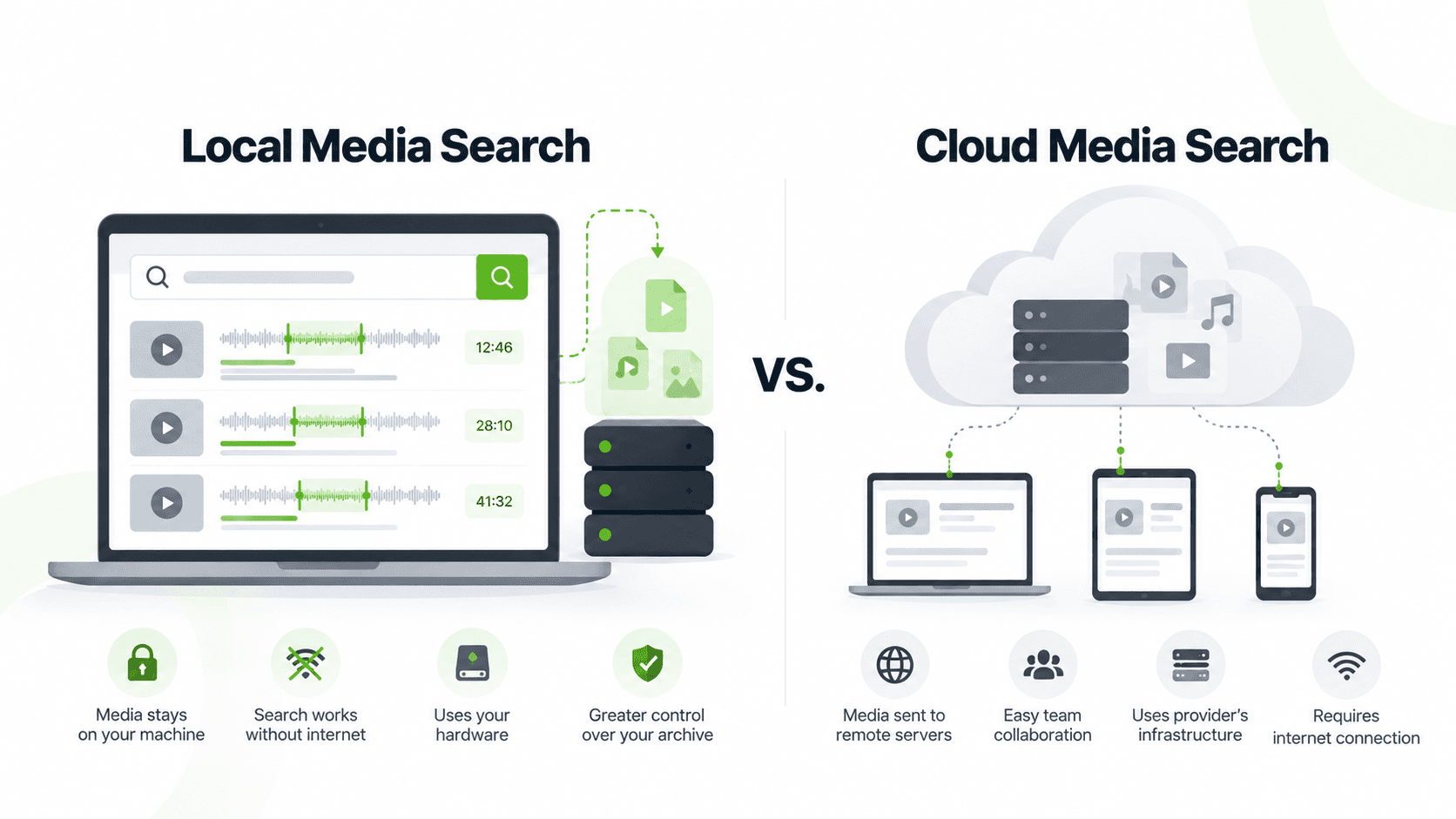
The question is not whether local software is always better than cloud software.
It is not.
The useful question is: Which architecture fits the media you work with and the way your team works?
A cloud-first tool usually sends content to remote infrastructure for processing.
A local-first tool performs the core media processing on your machine.
That distinction matters when recordings are sensitive, large or controlled by internal data-handling policies.
With Ugle, media transcription, indexing and search happen locally during normal operation.
That does not mean the application never communicates with a network. Licensing, validation and software updates are separate operational functions.
The important question is what happens to the content itself.
Cloud workflows depend on remote infrastructure.
That can be an advantage when teams need browser access or central collaboration.
Local workflows place more responsibility on the computer running the application, but the core search workload does not need to travel to a remote service.
Think about where you work.
A newsroom with controlled workstations may have different requirements from a distributed production company.
Cloud processing uses someone else's infrastructure.
Local processing uses yours.
That affects speed, hardware requirements and economics.
A powerful workstation may make local processing attractive.
Older hardware may process large archives more slowly.
There is no meaningful performance claim without specifying the machine, media and workload being tested.
Ask practical questions:
Architecture becomes meaningful when it changes those answers.
Cloud tools can be excellent for collaboration and remote access.
Local tools can be excellent when content control, predictable local retrieval and workstation-based workflows matter.
The right choice depends on the job.
Ugle was built for media professionals who want searchable recorded archives while keeping the core content workflow on their own machines.
Share this post