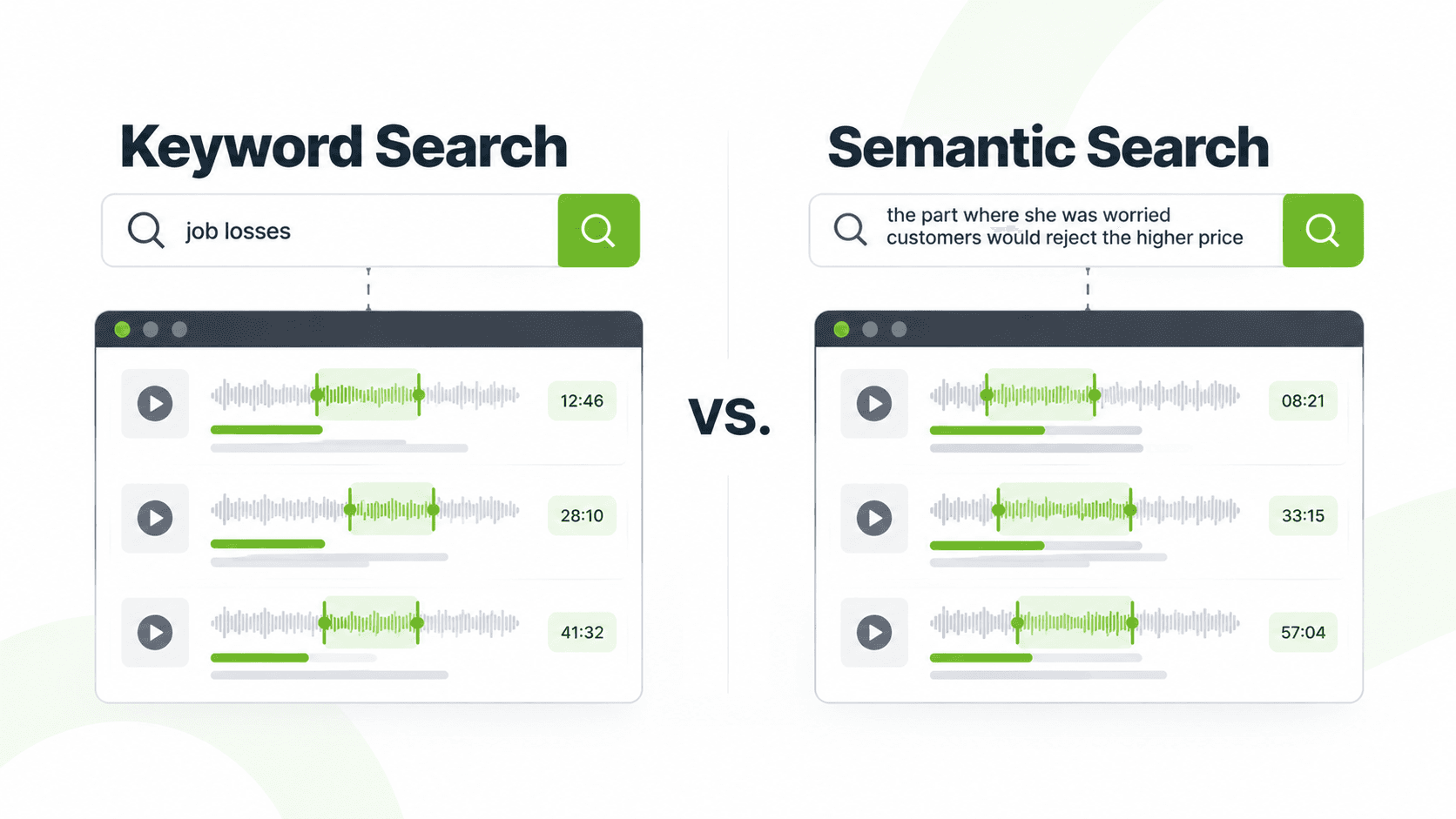
Keyword search asks:
“Where were these words used?”
Semantic search asks:
“Where was this idea discussed?”
For recorded interviews, both are useful.
They solve different retrieval problems.
Use keyword search when you know the language you expect to find.
Examples:
Exact terms can narrow the archive quickly.
The weakness appears when the speaker used different wording.
Search for job losses and you may miss a passage about reducing headcount.
Semantic search compares meaning rather than relying only on exact term overlap.
That makes it useful when you remember the substance of a conversation but not the sentence itself.
“the point where she was worried customers would reject the higher price”
“I wasn't sure people would accept what we needed to charge.”
The wording differs.
The idea is similar.
Human memory is inconsistent.
Sometimes we remember a precise term.
Sometimes we remember a theme.
Sometimes we remember only the emotional or editorial point.
Restricting a media archive to exact keywords means asking your memory to behave like a transcript.
It does not.
Ugle combines keyword and semantic retrieval so you can approach the archive from either direction.
Semantic search does not mean asking a model to invent an answer about your recordings.
For editorial work, the valuable result is the original passage.
Search should point you toward the source, show you where it occurred, and let you check it yourself.
Use both to find the Moment you remember.
Share this post