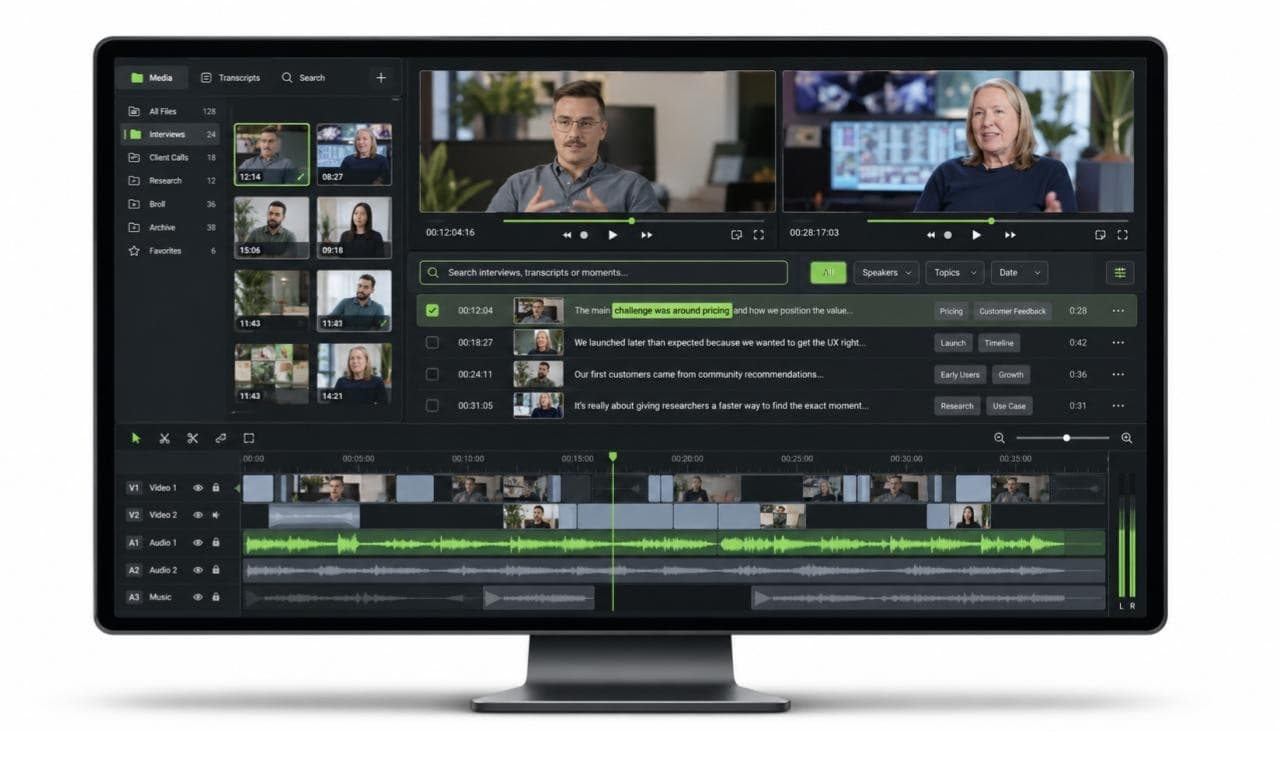
The best media-search benchmark is not a polished vendor demo.
It is your archive.
Before choosing a search tool, test it with recordings that represent the work you actually do.
Choose several files where you already know what was discussed.
Include a mix of:
The goal is not to find the easiest possible example. It is to see how the product behaves on your material.
Search for a phrase you know appears in the recording.
This tests basic lexical retrieval.
Now stop using the actual words. Search for the idea instead.
“customers were not willing to pay what we originally expected”
“the part where pricing was becoming a problem”
This is the more realistic test for semantic search. It reflects how people often remember recordings.
A result without a route back to the source is much less useful for professional media work.
Check whether you can: open the recording, play the relevant passage, see the timestamp, inspect surrounding context, and confirm the source file.
Retrieval should remain auditable.
Ask where processing occurs.
Ask where transcripts are stored.
Ask where indexes live.
Ask what network communication occurs.
Ask what happens to data after the licence ends.
Do not settle for a one-word answer such as “private.”
Understand the mechanism.
A technically impressive model can still sit inside a frustrating product.
Measure how many steps it takes to move from:
I remember something → Here is the exact source Moment.
That is the job.
Request a Ugle trial and test it with the recordings you actually work with.
Share this post